Monopoly Rights in a Veterinary Franchise Agreement: The Complete Guide – Vetnation Pharma
The animal healthcare industry is experiencing unprecedented growth. As the demand for quality livestock, poultry, and pet healthcare products surges, establishing a business in this sector has become a lucrative opportunity. For entrepreneurs, medical representatives, and distributors, partnering with an established veterinary PCD franchise offers a proven path to profitability. However, long-term commercial success depends on one fundamental pillar: securing monopoly rights in a veterinary franchise agreement.
Without clearly defined monopoly rights, a franchise partner risks competing against the very brand they are trying to promote within their own local market. Understanding how monopoly rights work, what legal clauses protect your territory, and how to select a trustworthy partner like Vetnation Pharma is crucial before signing any contract.
This detailed guide explores everything you need to know about monopoly rights in a veterinary franchise agreement, ensuring you make informed decisions for your veterinary pharmaceutical business.
What Are Monopoly Rights in a Veterinary Franchise Agreement?
In simple terms, monopoly rights—often referred to as exclusive territory rights or exclusive distribution rights—grant a franchise owner sole authority to market, distribute, and sell a company’s product line within a pre-defined geographic location.
When you secure monopoly rights in a veterinary franchise agreement, the parent pharmaceutical firm guarantees that it will not sell its products directly to other distributors in your assigned zone, nor will it appoint another franchise partner within that same area.
In the veterinary PCD franchise (Propaganda Cum Distribution) model, this arrangement ensures that the marketing efforts, veterinary doctor visits, and brand awareness you build in your region yield exclusive financial returns for your business.
Why Monopoly Rights Matter in a Veterinary Franchise
Launching a veterinary pharma franchise requires a significant investment of time, capital, and effort. Franchise owners build relationships with local veterinarians, dairy cooperatives, poultry farm managers, and pet clinic owners.
Here is why obtaining monopoly rights in a veterinary franchise agreement is critical for your commercial success:
- Eliminates Local Price Wars: When multiple distributors sell the same brand in one city, they often undercut each other’s prices to gain clients. Monopoly rights preserve your pricing strategy and profit margins.
- Protects Marketing Investment: Every promotional sample, visual aid, product brochure, and doctor call you invest in benefits your business alone, rather than a competing local distributor.
- Builds Strong Customer Loyalty: Veterinarians and farm owners prefer working with a single, dependable stockist for a specific veterinary medicine franchise range.
- Ensures Consistent Business Cashflow: Predictable market boundaries allow for accurate stock forecasting, reducing both overstocking and product stockouts.
How Exclusive Territory Rights Work
Territory demarcation is the foundation of exclusive territory rights. When drafting a veterinary franchise agreement, the geographic boundary must be clearly stated using defined administrative boundaries.
Common Ways Franchise Territory Is Defined:
- District-Level Exclusivity: The franchise partner receives exclusive rights for an entire administrative district.
- City or Town Boundaries: For densely populated areas or high-demand livestock hubs, exclusivity may be granted for a specific city or cluster of towns.
- Postal/PIN Code Allocation: Specific PIN codes are mapped to ensure zero ambiguity regarding where each distributor operates.
Practical Example:
Suppose you secure monopoly rights in a veterinary franchise agreement for District A from Vetnation Pharma. If a veterinary clinic in District A requests boluses, injections, or nutritional supplements from Vetnation Pharma directly, the company will forward that business lead directly to you as the authorized regional partner. Conversely, you agree not to market or supply products into District B, where another franchise partner operates.
Key Clauses to Check in a Veterinary Franchise Agreement
Before signing any agreement terms, carefully analyze the contract structure. A well-written contract protects both the parent company and the franchise distributor. Look for these essential franchise agreement terms:
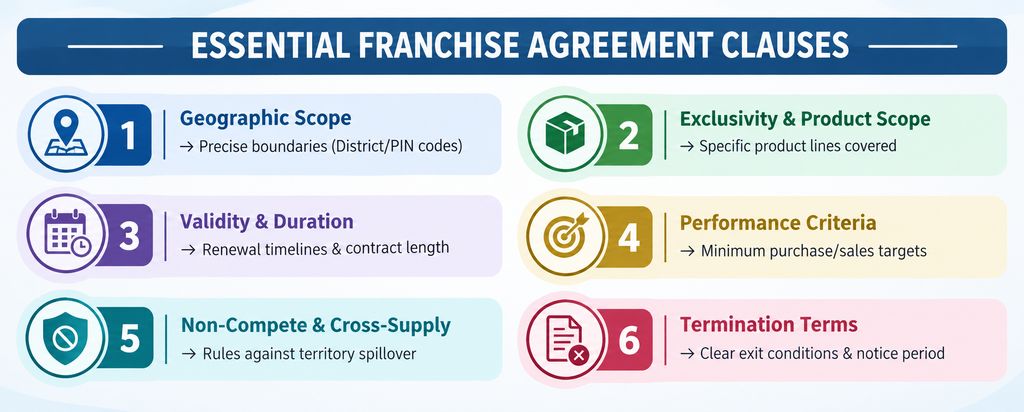
1. Geographic Scope Clause
The agreement must explicitly state your assigned territory name, district, or PIN codes. Vague phrases such as “nearby area” or “local market” should be avoided in favor of exact geographical terms.
2. Product Line Exclusivity
Confirm whether your monopoly rights in a veterinary franchise agreement cover the company’s entire veterinary range or only specific divisions (e.g., livestock cattle products, poultry supplements, or companion animal health formulations).
3. Agreement Duration and Renewal Provisions
Exclusivity is rarely permanent or automatic. Contracts are typically signed for 1 to 3 years. Ensure the agreement contains a clear renewal clause that outlines the conditions required to extend your territory rights upon expiration.
4. Minimum Sales Commitments and MOQs
Most pharma companies set reasonable Minimum Order Quantity (MOQ) benchmarks or quarterly sales goals. Understanding these target requirements ensures you maintain your exclusive territory rights without default.
5. Termination and Default Provisions
Review the conditions under which monopoly rights can be revoked. Transparent partners like Vetnation Pharma provide clear, written terms explaining default triggers, cure periods, and formal notice procedures.
Benefits of Monopoly Rights for Veterinary Franchise Partners
Partnering with a reputably managed veterinary pharma franchise that honors exclusive distribution rights offers distinct advantages:
- Higher Profit Margins: With no internal brand competition in your territory, you retain healthy profit margins without discounting product lines.
- Focused Business Growth: You can concentrate on expanding doctor call coverage, introducing new veterinary formulations, and scaling inventory without worrying about local brand poaching.
- Operational Autonomy: Having full ownership of your franchise territory allows you to hire sub-agents, sales representatives, or delivery staff tailored to local market demand.
- Strong Brand Equity: Over time, your distribution firm becomes synonymous with the high-quality veterinary brands you represent in your district.
Responsibilities of the Franchise Partner
While receiving monopoly rights in a veterinary franchise agreement grants valuable business exclusivity, it also carries key operational responsibilities:
- Active Market Coverage: You are expected to cover veterinarians, livestock farms, dairy cooperatives, and retail chemist shops across your assigned territory.
- Adherence to Territory Boundaries: Cross-territory selling (supplying stock into another partner’s designated zone) violates agreement terms and undermines network trust.
- Maintaining Adequate Stock: Keeping essential livestock boluses, feed supplements, dewomers, and antibiotics in stock prevents market shortage and maintains brand reputation.
- Timely Payment Schedules: Maintaining clean credit terms and fulfilling order commitments ensures smooth supply chain operations with your parent company.
Factors That Can Affect Monopoly Rights
Monopoly rights are legally binding contractual arrangements, but certain operational factors can impact or alter these terms:
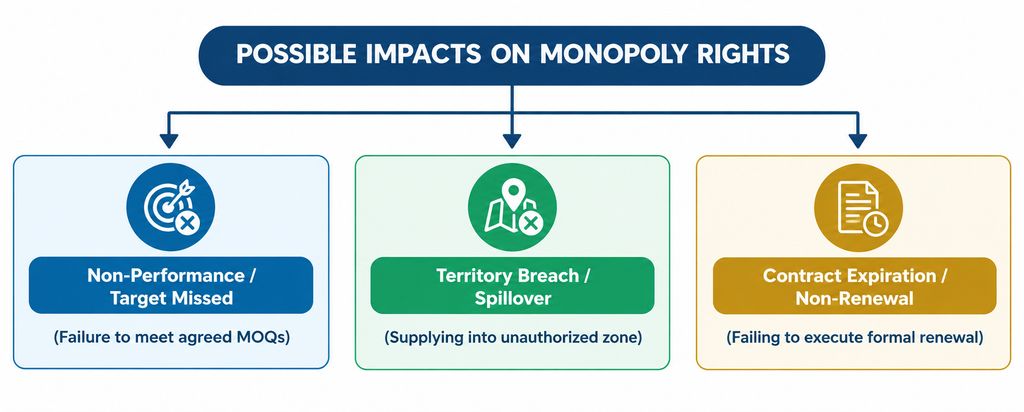
- Failure to Meet Agreed Sales Benchmarks: If a franchisee fails to meet basic purchase targets over extended periods, the parent firm may revise the territory scope or open sub-dealerships.
- Unauthorized Territory Spillover: Intentionally supplying stock to dealers outside your allocated zone is a primary reason for losing monopoly rights in a veterinary franchise agreement.
- Introduction of New Product Divisions: Companies launching completely separate divisions (e.g., establishing a dedicated pet care division alongside livestock) may offer existing partners first right of refusal before assigning new territory rights.
- Failure to Renew Contracts: Monopoly rights do not automatically extend indefinitely. Timely execution of renewal paperwork is required to maintain ongoing territory protection.
How to Protect Your Territory and Business Interests
Protecting your investment requires proactive management and adherence to professional distribution standards:
- Get Everything in Writing: Never rely on verbal assurances regarding territorial boundaries. Ensure all geographic definitions and exclusivity terms are clearly documented in your signed veterinary franchise agreement.
- Monitor Local Stock Flow: If you notice unauthorized stock of your company’s brand appearing in your district, report batch numbers and invoice details to your parent firm immediately.
- Maintain Transparent Communication: Regularly update your partner company on regional market trends, competitor activity, and stock demands.
- Meet Target Milestones Consistently: Fulfilling purchase commitments promptly is the most effective way to safeguard your monopoly rights in a veterinary franchise agreement.
Why Choose a Reliable Veterinary Pharma Franchise Company?
The true value of exclusive distribution rights depends on the credibility and quality of the parent company behind them. A contract granting exclusivity is only as strong as the products, supply reliability, and integrity of the manufacturing brand.
When evaluating potential partners, look for:
- WHO – GMP & ISO Certified Manufacturing: High-quality veterinary medicines built to strict standards ensure repeatable field results and vet recommendations.
- Comprehensive Product Portfolio: A versatile product line—including feed supplements, liquid oral formulations, boluses, powders, and injectables—helps maximize market reach across your territory.
- Attractive Promotional Support: Visual aids, sample kits, product cards, reminder cards, and promotional gifts assist your field team in building strong relationships with veterinary professionals.
- Ethical Business Policies: Transparent terms, prompt order processing, and strict enforcement of territory boundaries protect your long-term business interests.
How Vetnation Pharma Supports Veterinary Franchise Opportunities
As a recognized leader in the veterinary pharmaceutical business, Vetnation Pharma is dedicated to empowering franchise partners through professional support, premium product lines, and transparent business terms.
Key Advantages of Partnering with Vetnation Pharma:
- Genuine Monopoly Rights: Vetnation Pharma respects territorial boundaries, granting dedicated monopoly rights in a veterinary franchise agreement so partners can build their market with total confidence.
- High-Quality Veterinary Formulations: Our extensive portfolio is manufactured under stringent quality control standards, ensuring high efficacy for cattle, poultry, swine, and companion animals.
- Complete Promotional Backup: We equip our PCD partners with professional visual aids, product literature, glossaries, gifts, and promotional materials designed to impact veterinarians and stockists.
- Reliable Logistics and Stock Availability: Our efficient supply chain management ensures order execution without unexpected delays or stock shortages.
By combining ethically structured franchise agreement terms with top-tier veterinary products, Vetnation Pharma offers a strong foundation for both new entrepreneurs and established distributors seeking sustainable growth in the veterinary market.
Frequently Asked Questions (FAQs)
1. What does monopoly rights mean in a veterinary franchise agreement?
In a veterinary franchise agreement, monopoly rights give a franchise partner exclusive authorization to sell and distribute the parent company’s veterinary product range within a specified geographic area (such as a district or PIN code), ensuring no other partner is appointed in that exact location.
2. Are monopoly rights automatically permanent in a PCD franchise?
No. Monopoly rights are governed by the terms specified in your written agreement. They are typically granted for a defined period (e.g., 1 to 3 years) and are subject to contract renewal, compliance with territory rules, and meeting basic agreed purchase commitments.
3. What happens if another distributor sells the same brand in my monopoly territory?
This is known as territory spillover or cross-selling. If you notice unauthorized stock in your zone, you should document the batch numbers and notify your parent company like Vetnation Pharma. Ethical pharma companies investigate such breaches and enforce strict territory guidelines.
4. Can a company revoke my monopoly rights?
A company can modify or revoke monopoly rights if contractual terms are breached—for instance, if a distributor fails to meet agreed minimum order targets over an extended period, engages in cross-territory supply, or fails to execute contract renewals.
5. How is the territory defined in a veterinary PCD franchise agreement?
Territories are typically defined by administrative districts, major cities, or specific clusters of postal PIN codes. It is important to ensure these boundaries are explicitly written down in the formal agreement before signing.
6. Do monopoly rights cover all products of the veterinary pharma company?
Not always. Exclusivity depends on the specific agreement terms. Some contracts cover the company’s entire veterinary medicine range, while others may apply to specific product divisions (e.g., cattle care vs. pet care). Always review product scope details before finalizing your contract.
Conclusion
Securing monopoly rights in a veterinary franchise agreement is one of the most critical steps in establishing a profitable veterinary PCD franchise. Exclusive territory rights protect your hard work, safeguard your financial investments, prevent local price erosion, and give you the confidence to build strong relationships with veterinary healthcare professionals.
Before entering into any contract, carefully review all franchise agreement terms, clarify product scope, verify target commitments, and ensure your territory limits are defined in writing. By partnering with a transparent, quality-focused partner like Vetnation Pharma, you gain access to superior veterinary formulations alongside genuine territory protection designed for long-term commercial success.